
Software Development T-Level - Level 3
Start Date: 1st September 2026
- Length 2 years
- Study Full-Time
- Location Carlisle College
More about the course
If you enjoy problem solving, logical thinking and creating things that people use, this course is designed for you.
This T Level focuses on designing and developing software systems not just using technology, but understanding how it works and building it yourself.
You’ll learn how apps, websites and digital platforms are created from the ground up and gain the skills employers need in today’s development industry.
Unlike the Cyber Security route, which focuses on protecting systems, this pathway is about building them. The tech industry needs people who can build digital systems not just maintain them. This course prepares you for roles in software and web development by teaching the practical skills employers look for: coding, problem solving and collaborative development.
You’ll gain experience creating working applications and learn how professional development teams design, test and deliver software.

Entry requirements
-
You will require a minimum of 5 GCSEs at Grade 4 or above, including IT/Computer Science and GCSE English, maths.
or
- Merit grade or higher in Level 2 Technical Diploma in Digital Technologies plus GCSE English and maths at Grade 4 or above.
Scottish equivalent
-
5 National 5s at grade C or above including English and Maths/Applications of Maths
Please note that entry requirements and course offer can be subject to change at any time.
What will I achieve?
Upon successful completion of this course you will achieve a Pearson Level 3 T Level in Software Development.
What will I learn?
You’ll develop practical programming and development skills while understanding how professional software teams work.
Core knowledge
- Programming fundamental
- Digital environments and architectures
- Data and databases
- Planning and analysing digital projects
- Testing and debugging
- Digital legislation and ethics
- Security principles (from a developer perspective)
Development skills
- Writing and structuring code
- Designing user-focused applications
- Version control and collaboration
- Testing and improving software
- Problem solving and logical thinking
- Working to a real client brief
- Problem solving
- Introduction to programming
- Emerging issues and impact of digital
- Legislation and regulatory requirements
- Business context
- Data
- Digital environments
- Security
You will also complete an occupational specialism component (Digital Production, Design and Development).
Alongside your studies you will undertake a substantial work experience placement of at least 45 days.
How is the course taught?
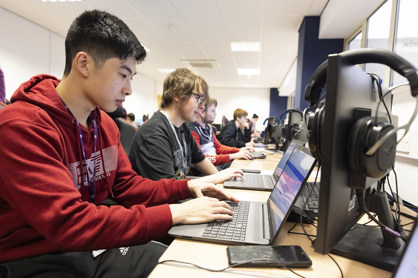
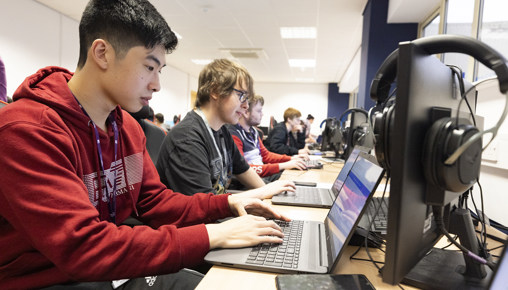
- Practical coding workshops
- Collaborative development projects
- Practical sessions
- Theory sessions
- Work placement
- Employer-set project (ESP)
How am I assessed?
- Written examinations (core knowledge)
- Occupational specialism project (software development)
- Employer-set project (ESP)
Work experience opportunities
Work experience is an important part of your T-Level. You will undertake a substantial industry placement with an employer for a minimum of 45 days during your course to help you prepare for your next steps. You will also undertake an employer-set project as part of the course.
English and Maths
English and maths skills are vital to all roles in digital and these are embedded throughout the course to help you prepare for working in the industry. Key skills will include presenting information and ideas, understanding data and risk and processing and analysing numerical data.
Where can I progress?
On successful completion of this course, you may progress into industry in a variety of entry-level roles or apprenticeships, such as roles in web and software development, computer gaming and eLearning.
Alternatively, you can progress into higher education.
Course Costs
If you are aged 16-18 when you begin your course you are eligible for free tuition. Detailed information can be found within the financial support section.
Meet our Tutors and Students
Marc Newrick
HE Computing TutorMarc is a lecturer in Computing, with a focus on Software Development and Cyber Security, teaching from Level 2, all the way up to level 6 (Undergraduate Degree level) at Carlisle College. He has worked at the college for 6 years, having previously worked for a Cumbrian website and web application development agency, working his way up from a Junior to Senior Developer over the course of his career. Having been a student himself at the college, studying a Level 3 in Computing, Marc was once in the position of his students, and can pass on his own experiences and knowledge of breaking into the computing industry, as well using his own industry based experience to support and develop best practice, skills and knowledge in his learners. Marc recently completed his Master of Science (MSc) in Cyber Security at The Open University.
Lucy Newrick
Computing and Business TutorI began working at Carlisle college during the COVID-19 pandemic in 2020, and since then I have taught across level 1 & 2 courses all the way up to our degree courses in both Computing and Business. Before joining the college, I have worked in a range of different industries including retail, hospitality, marketing, and management. Alongside this, I have also continued my own education and gained qualifications which include a BA (Hons) Performing Arts, and an MSc in Business Management and Finance. Working in education is something I love doing, because it allows me to build connections with learners and see them flourish in a subject they are passionate about.
Fionn Mclaughlin
Student Govenor - IT StudentI enjoyed the course and my experience at Carlisle College. I had access to great facilities and knowledgeable tutors with up-to-date insight and experience in the digital industry. Events ran by the college, like the John Stevenson Skills Fair, were particularly useful as speaking to the numerous companies allowed me to see what jobs were available after I completed my studies. Using the skills I have gained from my course, I'll continue with further studies by attending university to study computer science. You don't have to be massively interested in computers or IT to do this course, if you are, then it would still be a great place for you to study. I chose it because I wanted to learn more about computer science and considered it a strong career path to go into. The course and my experience provided me with strong skills, both soft and practical, which I can now apply to many different jobs.
Get in touch
Computing
Gallery
What's happening?
Course Added
This course has now been added to your basket. Please click below to apply now or contine browsing.
Apply Now
How is College different to Sixth Form?

How to Apply
Student Life
Fees and Finance